
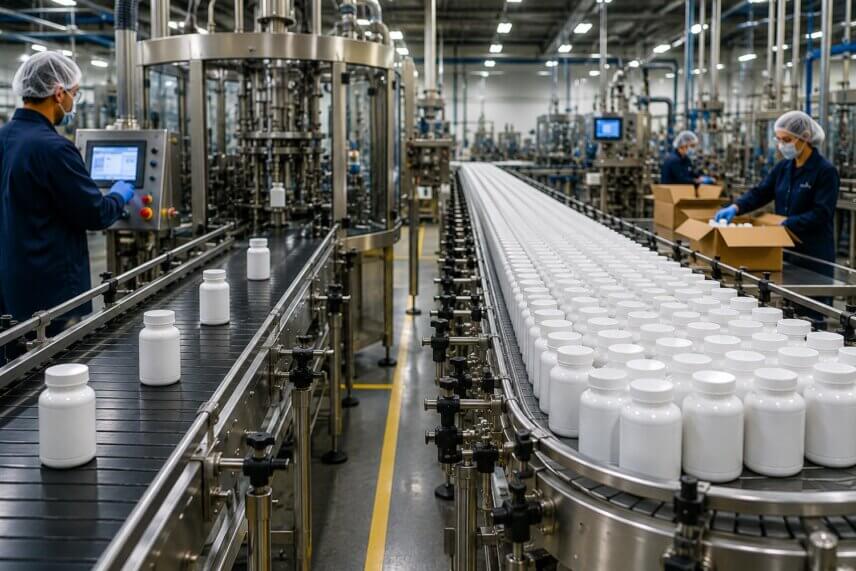
Minimum order quantities, commonly shortened to MOQs, represent one of the first hard numbers a brand encounters when outsourcing production to a contract packaging partner.
For brands and founders accustomed to small batches, the figure can arrive as a shock. A co-packer may set a minimum in the tens of thousands of units per SKU, and in higher-volume formats well beyond that, before a project becomes viable. Understanding why the number exists, what counts as normal across the industry, and how to work within it allows a brand to plan with confidence.
Outsourced packaging continues to expand as brands shed asset-heavy production lines. The global contract packaging market was valued at roughly 79.69 billion dollars in 2025 and is projected to reach 120 billion dollars by 2030, a compound annual growth rate of over 8.5%, according to Mordor Intelligence.
Industry estimates also suggest that outsourcing packaging can lower total production costs by 7-9%, as reported in contract packaging market analysis. As more companies turn to contract packaging partners, the MOQ conversation becomes one that nearly every product brand eventually encounters.
Why Minimum Order Quantities Exist
A minimum order quantity is not an arbitrary barrier. It reflects the fixed costs that accompany every production run, regardless of its size. Setup, equipment calibration, line changeover, quality checks, and teardown consume roughly the same time and labor whether a run produces two thousand units or two hundred thousand. Spread across a small run, those fixed costs inflate the price of every unit. Spread across a larger run, they fall toward the margins and nearly disappear.
“Setting MOQs really helps ensure profitability for the manufacturer.”
—Mitch Madoff, Keychain.com
The logic is straightforward. Consider a single fixed task, such as cleaning a line between jobs. If that task costs one hundred dollars, it adds one dollar to every unit across a one-hundred-unit run, yet only ten cents per unit across a thousand-unit run. Multiply that pattern across every fixed cost in a packaging operation, and the rationale for a minimum becomes clear.
Scheduling adds another layer, since a plant reserves a line, a crew, and a calendar slot for each job, and idle capacity is lost revenue. A co-packer that accepts runs below its threshold either absorbs the loss or returns the inefficiency to the brand as a below-minimum premium.
Material minimums compound the issue. Packaging suppliers set their own thresholds, and those numbers often exceed the production minimum. A co-packer might agree to fill five thousand bottles, while the bottle supplier sells those bottles only in lots of fifty thousand. That mismatch is a frequent source of cash-flow strain for new brands. Even a flexible packing partner cannot move the floor set by the material supply chain beneath it.
What Counts as a Normal MOQ
No single number defines a normal MOQ, because the figure shifts with product format, packaging type, and the equipment a run requires. A high-speed pouch line and a hand-assembled retail display operate on different economics, and their minimums reflect that gap.
Typical MOQ ranges by packaging format:
| Packaging format | Typical MOQ range | Best use case |
|---|---|---|
| Pilot or test run | 1,000 to 5,000 units | Product validation, early sales testing, and line trials |
| Small assembly or kitting | 5,000 to 15,000 units | Simple hand-packed projects, kits, and limited retail tests |
| Bottling or filling | 10,000 to 50,000 units | Supplements, beverages, sauces, liquids, and powders |
| Retail-ready packaging | 25,000 to 100,000 units | Full-service programs with filling, secondary packaging, and assembly |
| High-volume automated runs | 100,000+ units | Established CPG brands, club-channel formats, and national rollouts |
| Custom packaging components | Often 25,000 to 500,000+ units | Custom bottles, pouches, cartons, films, labels, and printed materials |
Published benchmarks offer a reasonable starting point for a brand building its first forecast, provided the brand treats them as ranges rather than fixed quotes.
Typical Ranges by Format
Across consumer packaged goods, MOQs can fall anywhere between roughly 1,000 and 100,000 units per SKU, and in higher-volume formats a single run climbs upward of 500,000 units per run. Format drives that spread. Pilot batches sit at the low end, while filling, bottling, and full retail-ready programs rise quickly toward the middle and top of the range. Custom packaging raises the floor even further, since the packaging supplier adds its own minimum on top of the manufacturer’s.
Set against that range, our typical starting minimum at 25,000 units per SKU per run sits squarely in normal, mid-market territory. It reflects the full-service, retail-ready nature of the projects we coordinate, which often combine filling, secondary packaging, and assembly within a single program. Brands launching supplements or food and beverage products should expect format and scope to drive their specific quote far more than any single industry average.
Production MOQ vs. Packaging MOQ
One distinction trips up many first-time buyers. The production MOQ set by a co-packer and the material MOQ set by a packaging supplier are separate numbers, and they rarely match. A production run may clear at one volume while the bottle or pouch supplier sells only in far larger lots, which can leave a brand holding components it will not use for months.
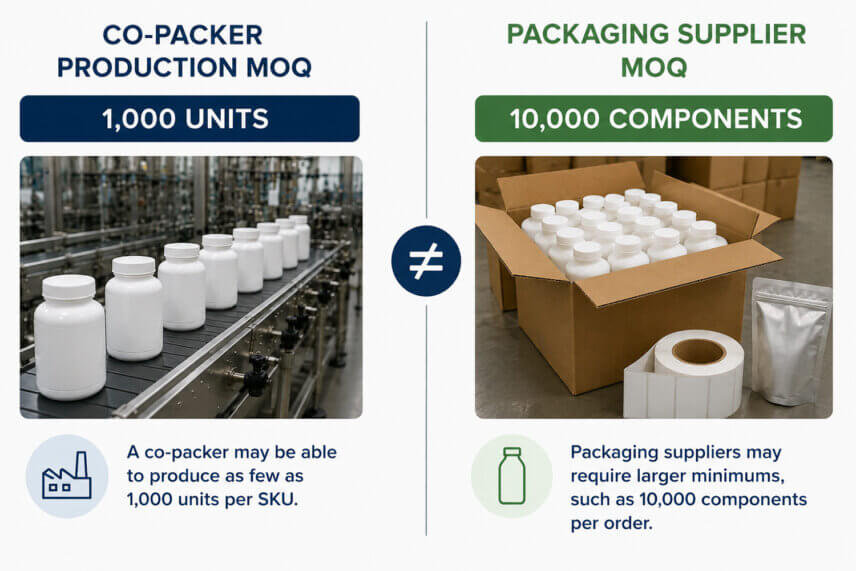
Confirming both figures early, and asking whether a supplier will hold and release stock in stages, prevents that mismatch from straining cash flow.
How to Work Within Minimum Order Quantities
A minimum that exceeds a brand’s comfort level rarely ends the conversation. Several established tactics align volume with efficient production, and most deliver benefits beyond simply clearing the threshold. The approaches below recur across successful product launches.
Consolidate SKUs and Standardize Components
Consolidating SKUs concentrates volume. A line of three flavors in three sizes becomes nine separate items, each requiring its own run and its own setup. Trimming to proven sellers and sharing components across products, such as a common pouch or a shared carton, pools volume so minimums clear faster. Standardizing flexible packaging lowers the effective minimum, because a single component order amortizes across multiple production runs.
Forecast Accurately and Plan for Packaging Costs
Honest forecasting prevents costly repetition. A brand that orders a small run to limit risk, then reorders weeks later at the same size, pays the setup premium twice. When a twelve-month forecast supports the volume, a single larger run generally costs less per unit than two constrained ones. Building packaging into the cash-flow plan from the start, rather than treating it as a launch-day surprise, keeps the math manageable. Our prior article on cost-saving guidance points to budgeting roughly 10 percent of a retail item’s total cost for packaging.
Bundle SKUs Into Variety and Multipacks
Bundling absorbs volume while serving real demand. Combining several SKUs into a variety pack or multipack rolls smaller individual runs into one efficient production order. Retailers favor assortments, and club channels depend on them, which means a brand can clear a minimum and strengthen its retail position in the same move. Subscription boxes and trial-size assortments extend the same logic, turning one coordinated run into several shelf-ready offers without inflating any single flavor commitment.
Request a Pilot Run
Pilot runs offer a measured entry. Many co-packers will produce a small pre-production batch below their standard minimum, typically in exchange for a per-unit premium that reported benchmarks place between 15 and 40 percent above standard pricing. That premium is not a penalty. It is the genuine cost of a short run, and it allows a brand to validate a product, confirm line settings, and gather early sales data before committing to full volume. The figures from that pilot then sharpen the forecast that justifies the first full run.
Negotiate and Build Supplier Relationships
Communication and a credible growth story carry weight as well. Suppliers more readily accommodate a smaller first order when a brand demonstrates clear intent to scale and orders on a consistent, predictable pattern. Proximity matters too, and a national network that spans regional plants can offer flexible, nearby capacity without binding a brand to a single location’s terms.
Match Volume to the Right Facility
Matching volume to the right facility changes the equation entirely. Most conventional advice assumes a brand is negotiating with a single plant and is therefore bound by that plant’s minimum. A network model removes that constraint. We coordinate a network of more than 300 co-packers, each with distinct equipment, capacity, and run-size economics, and match a project to a facility where the volume fits. A run that strains one plant may sit comfortably within another, often at a lower effective minimum and at a location that already holds the SQF, NSF, or Organic certifications a product requires. Because we manage that match and the project that follows from a single point of contact, a brand gains the right plant without having to vet, negotiate, and coordinate each option alone.
The Bottom Line
Minimum order quantities reflect the economics of producing packaging efficiently, not a barrier built to exclude smaller brands. Once a brand understands why the minimum exists, what is normal for its format, and which levers adjust the math, the number becomes a planning input rather than an obstacle. Consolidating SKUs, forecasting honestly, bundling strategically, and matching volume to the right facility each move a project toward efficient production and a healthier per-unit cost.
The next decision, once volume is settled, concerns which partner runs the work, a process covered in how to find the right co-packer. Brands weighing a new project can request a quote to discuss their target volume, product format, and the most efficient path to a finished, shelf-ready product.
